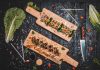

The original name of this unique product, known as waxed roe in Turkey, or candles on the stalls, is Bottarga. We would like to give you some information about this delightful and unique flavor candle roe.
What is Bottarga?
Bottarga is the sac of a fish, usually mullet, that is salted, massaged to expel air pockets, then pressed and dried. It is a delicacy to be produced and used all over the world, and its history goes back to ancient times.
- It seems that almost wherever humans hunted, after learning this preservation technique, they removed the roe sacs and salted and dried them to produce an extremely tasty pantry staple that resists decay.
Bottarga is great to eat with vegetables, grated on just about any starch or grain, or simply on its own, flavored with thinly sliced paper and some salt or soy sauce, a dash of lemon, and a dash of savory oil.
Known as ‘Mediterranean caviar’, bottarga can be thought of as the truffle of the sea, as it is grated on the dishes just like mushrooms. It has its own unique aroma and flavor.
They used the most ancient and common preservatives to preserve the delicious and delicate eggs:
There are some regional differences when it comes to making bottarga.
🐟 What is Bottarga?

What fish is bottarga made from?
Botarga is generally made from mullet, but in different countries also made of fishes such as tuna.
How to make bottarga
- Despite the differences, both varieties are made pretty much the same.
- Roe deer sacs of the fish are carefully removed from the belly of the fish so as not to damage the membrane containing the egg.
- Fish bags are washed in ice water, and carefully massaged by hand to eliminate air pockets.
- They are then cured in sea salted, which is usually set in overlapping layers for several weeks, although this will vary depending on climate and manufacturer preference.
- The resulting boards are washed again and pressed to remove salt water and other liquids.
- After that, the aging phase begins; the boards are taken to a large “aging room” that must be well ventilated and dried, either hung from the ceiling or more often laid on wooden shelves.
- To achieve a uniform drying process, they must be rotated periodically and matured for up to several months, depending on the size of the egg.
How to eat bottarga?
Where is botarga used? The most common and enjoyable way of eating; It is a simple eating of thinly sliced pieces.
Bottarga recept, Bottarga, bottarga caviar can be eaten by placing it on a toasted bread with olive oil poured on it. Or a slice of toasted bread with butter on it can be eaten with pleasure.
Although it is not very common in Turkey, pasta is also served by grating on different products such as pasta.
There are some differences between bottarga-like products of different cultures:
In Turkey, it is covered with beeswax, which acts as a preservative. In far east countries like in Japan and Taiwan, smiler product is called karasumi. However, it is not as thoroughly dried as Mediterranean bottarga and is a bit softer as a result.
It is obtained by bottarga roe, the raw cooking method. It is known that this product, whose name is frequently heard with Masterchef bottarga or botarga, has been made in our country for 100 years.
Where to buy Bottarga ?
Bottarga is manufactured in many locations but we advise you to taste the Bottarga from Turkey Adana Karatraş. It’s well know with their quality and export capacity to many countries. You are wellcomed to contact this old family company.
🐟 Sudi Su Ürünleri ⚓️
🦐Location: Kemaliye mah. 130sk No:1/A Karataş/Adana – Turkey
🦀 Contact Number :0090 532 270 16 78